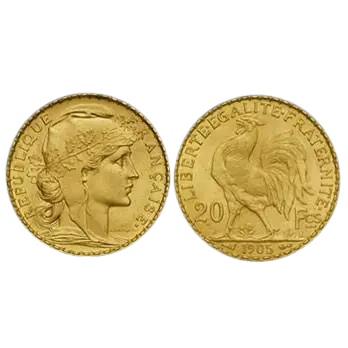
Napoleon 20 Francs
The 20 francs Napoleon is France’s most iconic gold coin. Introduced in 1803 under the Consulate, it was struck until 1914 and spanned the entire 19th century: First Empire, Restoration, July Monarchy, Second Empire and Third Republic. Each regime placed its own effigy on it — Napoleon I, Louis XVIII, Charles X, Louis-Philippe, Napoleon III — before the Republic replaced it with Dupré’s winged Genius and then with Jules-Clément Chaplain’s Marianne with rooster, struck from 1899 to 1914. The name “Napoleon” has stuck to all of these coins.
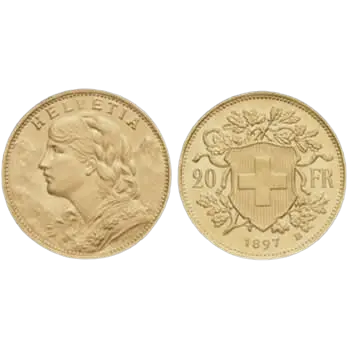
The coin weighs 6.45 g in total, with a fineness of 900‰: 90% gold and 10% copper. Of these 6.45 g, 5.81 g are pure gold. This standard, set in France in 1803, was adopted by the Latin Monetary Union in 1865, which is why the Swiss (Vreneli), Belgian and Italian 20 francs contain exactly the same amount of gold.
The price of a gold coin follows the amount of pure gold it contains, not its total weight: it is these 5.81 g of fine gold that determine the price of the Napoleon, whatever its year or effigy.