Gold bars in your luggage, international delivery, import from Geneva — each scenario is subject to specific rules. This guide details the thresholds, required documents, and costly mistakes.
Why customs is a serious issue
Physical gold is legal to transport in the vast majority of countries, but this legality is conditional: it requires compliance with declaration rules, value thresholds and, often, strict identification procedures.
An honest mistake—such as an undeclared ingot or a missing document—can lead to the temporary or permanent seizure of the metal, a substantial fine, or even criminal prosecution in cases involving large sums. These consequences are disproportionate to the simplicity of the procedures if they are anticipated.
Gold cannot be transported like a phone or jewelry. It is a financial asset subject to the same reporting requirements as cash and monetary instruments.
This guide covers three main situations: travelers physically carrying gold in their luggage, delivery by carrier or courier, and commercial import. For each scenario, Swiss and European regulations are presented separately and then compared.
Investment gold: legal definition
The distinction between investment gold and jewelry gold is not insignificant: it determines the applicable VAT regime and, in some cases, the reporting obligations.
In European law (Directive 2006/112/EC)
Investment gold includes ingots and bars with a purity of 995 parts per thousand or higher (99.5%), as well as gold coins minted after 1800 with a purity of at least 900 parts per thousand that are legal tender in their country of origin. These products are exempt from VAT in all EU member states.
In Switzerland
The Federal Act on Value Added Tax (VAT Act) provides a similar exemption for gold bars or granules of bank-grade purity (≥ 995/1000), as well as for legal tender gold coins. Gold jewelry (lower purity or manufactured items), however, is subject to Swiss VAT at the standard rate.
Important to note: An LBMA Good Delivery (999.9/1000) gold bar is systematically considered investment gold in both jurisdictions. It is exempt from VAT on purchase in Switzerland and on import into the EU, subject to certain conditions.
Customs regulations in Switzerland
Switzerland is not a member of the EU but is party to the Switzerland-EU Free Trade Agreement and to the Customs Union with Liechtenstein. It has its own import and export rules.
Export from Switzerland
In Switzerland, there is no minimum value below which a gold ingot can be exported without declaration. All commercial transport of goods must be declared to customs (form 11.49A or electronic procedure via the e-dec/NCTS system).
For a traveler who takes a gold bar for personal use, export does not require customs formalities on the Swiss side — but declaration upon entry to the country of destination remains mandatory if local thresholds are exceeded.
Good news. Switzerland imposes no quantitative restrictions on the export of investment gold. There are no quotas, export licenses, or export taxes on physical gold for residents or non-residents.
Importation into Switzerland
Investment gold imported into Switzerland is exempt from VAT (Article 107 of the VAT Act). Customs duties may apply to other forms of gold (jewelry, scrap), but not to gold bars.
Switzerland has been implementing the FATF recommendations on anti-money laundering since 2016. Precious metals dealers are subject to strict KYC obligations, but these obligations fall on the seller, not customs.
Customs regulations in the European Union
Regulation (EU) 2018/1672 on cash controls
This regulation, which entered into force on June 3, 2021, is the foundational text for any traveler entering or leaving the EU with valuables. Its scope extends beyond cash alone: it covers instruments similar to cash , which explicitly include gold in the form of coins, nuggets, and unfinished bars.
EU key threshold. Any traveler entering or leaving the EU with gold (bullion, coins, nuggets) worth €10,000 or more is required to declare it to customs. This obligation applies at every external border crossing of the EU.
The EU customs declaration
The declaration is made on the standardized form provided for by Regulation 2018/1672 (available online or at border crossings). It must specify the type of gold, the quantity in grams or ounces, the estimated value at the current market price, the country of origin, and the country of final destination.
If the threshold is exceeded and no declaration is made, customs authorities may seize the gold as a precautionary measure pending an investigation. The seizure may become permanent if a link to illegal activity is established.
Internal EU crossings
Customs controls have been abolished between EU member states (intra-EU travel). However, member states retain the right to carry out tax and police checks and may request proof of the origin of funds or gold being transported.
Note: Some Member States (France, Germany, Belgium) have introduced additional national reporting requirements to supplement the European regulation for precious metals transactions exceeding certain thresholds. Check with the customs authorities of the destination country.
Crossing the Swiss–EU border
The border between Switzerland and the EU member states (France, Germany, Austria, Italy) is a fully-fledged external customs border. Regulation 2018/1672 applies to both entry into and exit from the EU territory.
You are travelling from an EU country to Switzerland
If you are carrying gold worth €10,000 or more, you must declare it when leaving the EU. On the Swiss side, no specific formalities are required for travelers with personal use (see section Customs regulations in Switzerland).
You are entering an EU country from Switzerland
This is the most common scenario for a Geneva buyer returning home with a gold bar. The rules to be followed are those of the EU country of entry (France, Germany, Italy, etc.) combined with European regulations.
Caution. The €10,000 threshold is calculated based on the total value of the gold being transported at the current market price , not its purchase price. If you bought a 100g gold bar for €7,000 and the price has risen, its current value may exceed the reporting threshold.
The procedure in practice
- Calculate the market value of your gold at the exchange rate on the day of the transaction (spot rate XAU/EUR × weight in troy ounces).
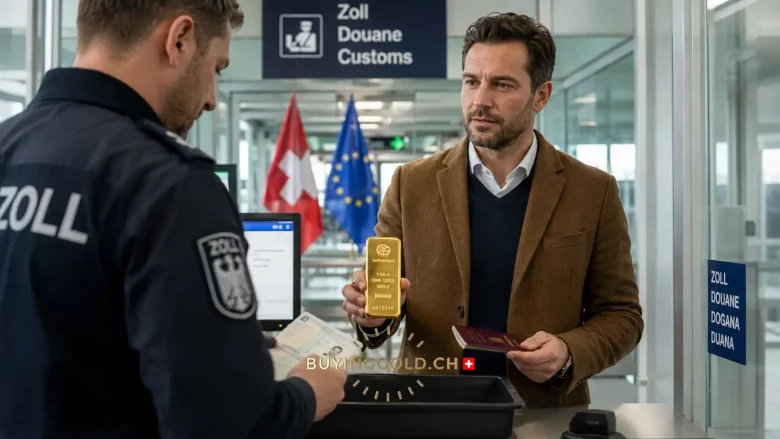
- If the value exceeds EUR 10,000, go to the customs counter (red line or dedicated office). Do not use the green line.
- Submit the completed declaration form, along with your supporting documents (purchase invoice, ingot certificate, passport).
- Answer the agents’ questions if necessary. The normal procedure takes 10 to 30 minutes.
- Keep the receipt for the declaration: you may be asked for it later.
Travellers from third countries
For nationals of countries outside the EU and Switzerland who wish to buy gold in Geneva and bring it back to their country, two borders must be anticipated: exiting Switzerland (almost unrestricted) and entering the country of destination.
| Country | Diet | Status |
| 🇬🇧 United Kingdom | The reporting threshold is GBP 10,000. Investment gold is exempt from VAT. Declaration is mandatory upon arrival if this threshold is exceeded. | ⚠️ Declaration required |
| 🇦🇪 United Arab Emirates | No restrictions on importing gold. Declaration required for values exceeding AED 100,000. | ✅ Favorable |
| 🇺🇸 United States | A FinCEN 105 declaration is mandatory if the total value exceeds USD 10,000. There are no customs duties on investment gold. | ⚠️ Declaration required |
| 🇸🇬 Singapore | No import tax on investment gold (GST exempt). Declaration required for cash > 20,000 SGD. | ✅ Very favorable |
| 🌍 Other countries | The rules vary considerably. India, China, Russia, and Türkiye have very specific regulations. Always check with the relevant customs authority. | ⚠️ Check on a case-by-case basis |
Comparative table of diets
| Setting | Switzerland (export) | Switzerland (import) | EU (entry) | EU (output) |
| Declarative threshold | No threshold | No threshold | 10,000 EUR | 10,000 EUR |
| Import VAT | N / A | Exempt (or investment). | Exempt (or investment). | N / A |
| Customs duties | None | None | None (or invest.) | None |
| Required form | No (personal use) | No (personal use) | Yes, if > €10,000 | Yes, if > €10,000 |
| Quantitative restriction | None | None | None | None |
| Risk of seizure | Weak | Weak | If not declared | If not declared |
| Reference text | LTVA art. 107 | LTVA art. 107 | EU Regulation 2018/1672 | EU Regulation 2018/1672 |
This table is provided for guidance only. Rules are subject to change. Consult the relevant customs authorities for any significant transactions.
Essential documents
Regardless of the threshold, having complete documentation protects your interests and expedites checks. These documents serve to establish the legitimate origin of the gold and prevent any suspicion of money laundering.
- Original purchase invoice — issued by the dealer (e.g. AchatOr.ch), mentioning the weight, purity, serial number of the ingot, the price paid and the date of purchase.
- Ingot certificate — document provided by the manufacturer (PAMP, Valcambi, etc.) attesting to the metallurgical characteristics and the unique serial number.
- Valid identity document — valid passport for foreign nationals; identity card sufficient for EU nationals in the Schengen area.
- Proof of funds — bank statement or proof of transfer showing that the funds used for the purchase come from a bank account identified in your name.
- Customs declaration form — to be completed if the value exceeds the applicable threshold. Downloadable from the OFDF website (Switzerland) or from the customs portal of the country of entry into the EU.
Practical tip: Always keep a digital copy of these documents on your phone or in a secure cloud storage service, in addition to the original paper copies. In case of loss or seizure of the physical documents, a digital copy will facilitate the recovery process.
Postal delivery and specialized carriers
If you are not taking your gold with you in your luggage, you have two options: armored courier or insured postal delivery. Customs regulations are the same, but responsibilities differ.
Cash-in-transit companies (Brink’s, Malca-Amit, Loomis)
These companies, specializing in the transport of precious metals, handle all customs formalities on behalf of the sender. They hold specific licenses and have established relationships with customs authorities. This is the safest and most professional solution for large shipments.
Insured postal delivery
Technically possible for small volumes, but strongly discouraged for security and insurance reasons. Most insurers cap coverage for postal shipments of precious metals, and postal services often refuse unaccompanied precious metals above a certain value.
Important: A package containing gold arriving in the EU from Switzerland is subject to the same customs regulations as a passenger. The sender or recipient must declare the goods and, if applicable, pay VAT if the item does not qualify as investment gold under the European directive.
Common mistakes and penalties
Don’t declare it thinking no one will look.
Metal detectors at airports and land border crossings systematically detect gold bars. X-rays reveal the characteristic shape of a gold bar even through checked baggage. The likelihood of being inspected is high for travelers arriving from Switzerland, a well-known center for gold trading.
Divide the transport among several people to stay below the threshold
This practice—known as “smurfing”—is explicitly identified as suspicious in Regulation 2018/1672. Customs officers are trained to recognize groups traveling together with split declarations. The consequences are the same as, or even more severe than, those of simple failure to declare.
Underestimating the value at the current rate
The declared value must reflect the market price at the time of the transaction, not the purchase price. If you bought a gold bar two years ago at a lower price and gold has since appreciated, the current value may push your shipment above the reporting threshold.
Penalties incurred
In the event of non-declaration or inaccurate declaration, EU customs authorities may: seize the gold for investigation (indefinite period), impose an administrative fine of up to 25% of the undeclared value, and, in cases involving large sums or repeat offenses, forward the case to the public prosecutor for criminal prosecution.
Customs FAQ
Yes, if the value is less than €10,000. With gold prices around €85–90/g (2025 prices), 5g represents approximately €425–450, well below the threshold. That said, it’s always wise to carry the purchase receipt.
Yes. Regulation 2018/1672 provides for an overall assessment that includes cash, bearer checks, prepaid cards, and gold treated as cash. If you are carrying €6,000 in cash and a €5,000 gold bar, the total exceeds the threshold and a declaration is mandatory for the entire amount.
No, investment gold (purity ≥ 995/1000) is exempt from import VAT in all EU member states, in accordance with Directive 2006/112/EC. There are also no customs duties on this type of gold. The obligation to declare it (if the threshold is met) does not automatically trigger taxation.
The seizure is initially precautionary: the authorities have a legal timeframe (which varies by country, generally 30 to 90 days) to investigate. If no criminal offense is established, the gold is returned, often after payment of an administrative fine. A lawyer specializing in customs law can expedite the restitution process.
Large express couriers technically accept precious metals under certain conditions, but their insurance coverage is often inadequate and the risks of loss or theft are higher than with a specialized cash courier. For significant amounts, it is strongly recommended to use Brink’s, Malca-Amit, or a similar authorized service.
In principle, customs and tax data are separate. However, in several EU Member States, customs and tax authorities may exchange information in cases of suspected wrongdoing. A compliant declaration, accompanied by a purchase invoice and proof of legitimate funds, should not generate any additional tax consequences.
Pre-departure checklist
- I calculated the market value of my gold based on the price on the day of departure.
- If this value exceeds EUR 10,000 (or the equivalent in local currency), I have downloaded and completed the customs declaration form of the country of entry.
- I have with me the original purchase invoice mentioning weight, purity and serial number.
- I have the certificate for the ingot (provided by the manufacturer or the trader).
- I can justify the origin of the funds used for the purchase (bank statement, transfer).
- I am familiar with the specific rules of the destination country (VAT, national thresholds, restrictions).
- I kept a digital copy of all these documents on my phone.
- If I travel in a group, each person carrying gold has their own documentation.
- For a large shipment (> 50,000 EUR), I contacted a specialized valuables carrier.
Key points to remember
- Switzerland does not impose any restrictions or formalities on the export of investment gold for personal use.
- The EU requires a customs declaration as soon as the value of the gold being transported reaches or exceeds EUR 10,000 at each external border crossing.
- Investment gold (purity ≥ 995/1000) is exempt from VAT upon entry into the EU — the declaration does not result in taxation.
- The value to be declared is the market value on the day of the transaction, not the purchase price.
- The threshold is assessed globally: cash + gold + other monetary instruments combined.
- Always keep the invoice, bullion certificate and proof of funds — regardless of the value transported.
- For large sums of money, a specialized cash-in-transit company is the safest and most professional solution.
- The rules of third countries (USA, UK, UAE…) vary greatly — always check on a case-by-case basis.