Luxury timepieces have evolved from instruments for measuring time to alternative assets integrated into wealth diversification strategies. Their value rests on a combination of tangible and intangible factors: materials, rarity, brand, and secondary market dynamics.
In an economic environment marked by uncertainty, certain watches are now considered safe havens, on par with precious metals such as gold or platinum.
Why are watches considered alternative assets?
A luxury watch is a physical, durable and tradable asset, classified among Hard Assets, that is to say tangible goods retaining an intrinsic value independently of financial systems.
The main reasons:
- Partial correlation with gold: gold or platinum watches indirectly follow the precious metals market.
- Decorrelation of financial markets: low dependence on stocks or bonds.
- Limited offer: production controlled by the manufacturers.
The concept of safe-haven value applies particularly to iconic models, whose demand remains stable even during periods of economic volatility.
Precious metals and high-end watchmaking materials
The materials used directly influence the value, durability, and liquidity of a watch.
Main materials used
| Material | Characteristics | Impact on Resale Value |
| Yellow Gold (18K) | Traditional, timeless, and chemically stable. | High Liquidity: Always in demand and holds a strong baseline value based on gold spot prices. |
| Rose Gold (e.g., Everose) | An alloy of gold and copper; offers a unique warm hue. | High Demand: Very trendy in the modern luxury market; often commands a premium in contemporary models. |
| White Gold | Gold alloyed with palladium or nickel; often rhodium-plated. | Discreet Luxury: Appeals to collectors seeking “stealth wealth.” Value is stable but can be slightly less liquid than yellow gold. |
| Platinum (950) | Extremely dense, rare, and naturally white; hypoallergenic. | Premium Tier: Positioned as the highest-end material. Highest entry price and excellent long-term value retention due to rarity. |
| Titanium (Grade 5) | Lightweight, highly corrosion-resistant, and technically advanced. | Niche Appeal: Values are driven by technical performance. While highly durable, it may be less liquid than precious metals in the classic investment sector. |
In watchmaking, 18-karat gold (750‰) is standard, unlike in jewelry where various purities are more common. Hallmarks guarantee the metal’s authenticity and facilitate resale.
Liquidity is generally higher for steel or gold watches than for titanium watches, due to stronger demand on the secondary market.
The pillars of value: Brand, Condition, and Origin
The valuation of a watch is based on three fundamental aspects.
The brand
Certain companies dominate the market:
- Patek Philippe
- Audemars Piguet
- Vacheron Constantin
- Rolex
These players benefit from global recognition, limited production and a solid track record in the secondary market.
The state (condition)
The state of preservation is critical:
- Unpolished: unpolished case, original angles preserved.
- Original parts: no uncertified replacements.
- Optimal mechanical operation.
A restored watch can lose value if the work done does not meet the original standards.
The origin
The concept of a Full Set includes:
- Original box
- Certificate of authenticity
- Bill
- Service history
Serial numbers allow for tracing the manufacturing process and verifying authenticity. Documented provenance can increase the value by 10 to 30%.
The watchmaking expertise process
A professional assessment follows a structured protocol:
- Movement authentication: caliber analysis.
- Verification of serial numbers and matching with the brand.
- Inspection of components (dial, hands, case).
- Precision test and power reserve.
There are two types of evaluation:
- Insured value: often higher.
- Market value: based on actual demand.
For a reliable valuation, a specialized service is recommended via a free online appraisal: https://buyinggold.ch/buy-watch/
Market trends and resale value
The watch market follows cycles influenced by:
- The limited production of the brands
- Global demand
- The grey market vs. secondary market phenomenon
The CPO (Certified Pre-Owned) segment has strengthened transparency and buyer confidence.
Current analysis:
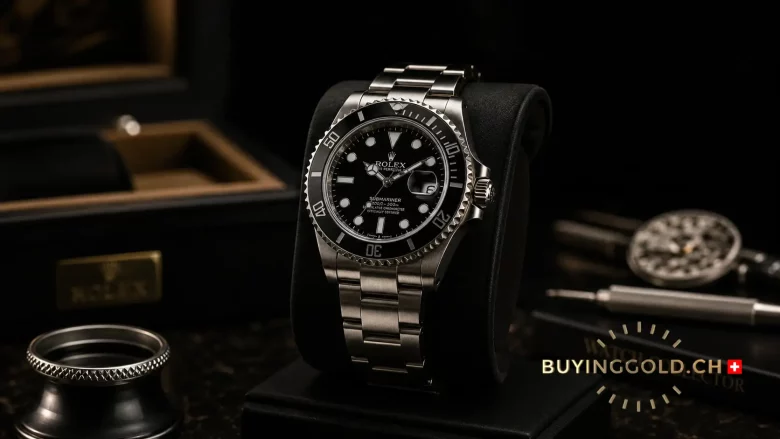
- Strong demand for Rolex sports watches
- Price stabilization after speculative peaks
- Growth of the second-hand market
To learn more: https://buyinggold.ch/the-revolution-in-the-second-hand-luxury-watch-market/
Storage, maintenance and security
The way a watch is preserved directly impacts its value.
Best practices
- Stable temperature (10-25°C)
- Controlled humidity
- Secure vault storage
Maintenance
- Recommended servicing every 5 to 7 years
- Lubrication of the movement
- Leak test
Regular maintenance preserves accuracy and prevents depreciation.
Investment Risks and Opportunities
Risks
- Advanced Counterfeits (Superclones)
- Price volatility
- Limited liquidity for some brands
Opportunities
- Discontinued models
- Limited editions
- Structured Secondary Market
Prudence dictates systematic verification through professional expertise.
To sell effectively: https://buyinggold.ch/selling-your-watch-a-return-on-investment/
Table: LVMH & independents vs value retention
Market Analysis: Brand Value Retention (5-Year Horizon)
| Brand | Value Retention (5 Years) | Investment Profile |
| Rolex | 90% – 120% | Market Leader: High liquidity and universal demand. Most steel professional models trade above retail price. |
| Patek Philippe | 95% – 130% | Blue Chip: Exceptional scarcity. Heritage models and the Nautilus/Aquanaut lines are primary drivers of growth. |
| Audemars Piguet | 85% – 115% | High Demand: Heavily driven by the Royal Oak collection. High volatility but strong appreciation for limited editions. |
| Vacheron Constantin | 75% – 100% | Stable Luxury: Part of the “Holy Trinity.” Offers steady value retention, especially within the Overseas and Historiques collections. |
| Omega | 60% – 80% | Growth Potential: Excellent technical value. Special editions (e.g., Speedmaster “Snoopy”) often outperform the brand average. |
FAQ – Watchmaking Investment
The best performing models are generally limited editions, iconic references or watches that are out of production with high demand on the secondary market.
The investment remains relevant within a diversification strategy. However, the market is showing periods of correction, requiring an analytical approach based on liquidity and brand.
The absence of a certificate of authenticity necessitates a technical analysis: inspection of the movement, verification of serial numbers, quality of finish, and consistency of components. A professional appraisal remains the most reliable method.
Beyond time: transforming an object into a heritage strategy
Luxury watches embody a hybrid logic, blending passion and investment. Rigorous selection, combined with in-depth watchmaking expertise, helps to secure their value and optimize their resale potential.